2026-11-04 ·
What Influences Tattoo Removal Cost in the Valley
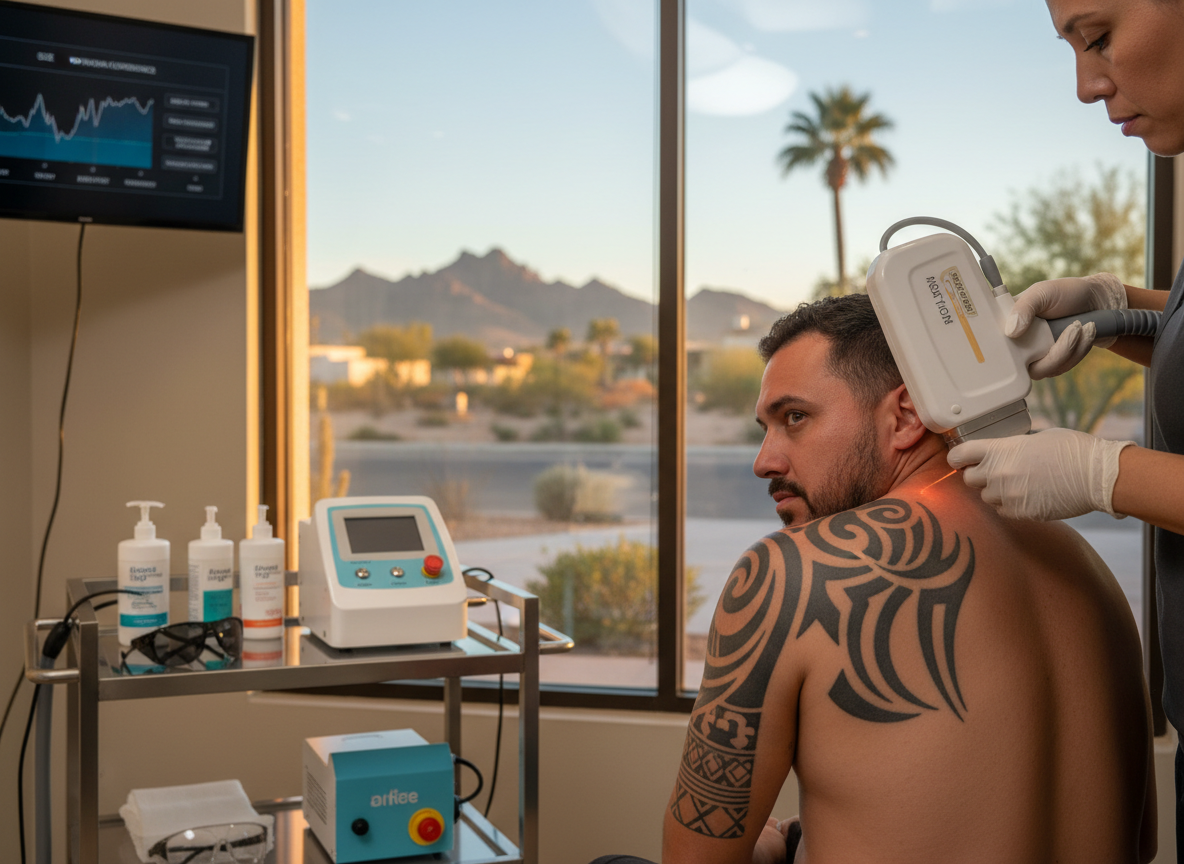
Most tattoos in the Valley cost somewhere between $75 and $500 per session, with a full removal typically taking 6 to 12 sessions spaced 8 to 10 weeks apart. That means a small black wrist tattoo might run $500–$1,200 total, while a large colored piece on a shoulder or back can easily climb past $4,000 across the full course of treatment. Those are honest ranges for laser tattoo removal in Maricopa County — but the exact number for you depends on a handful of factors I evaluate every day on clients from Downtown Gilbert, Power Ranch, and over from Chandler and Mesa. Here's what actually moves the price.
Tattoo Size and How It's Priced
Size is the single biggest driver. Most studios, including mine, price by the square inch or by size bands: a $75–$150 band for something under 2x2 inches, $150–$300 for a medium piece up to roughly 4x6 inches, and $300–$500+ for large work. A small anchor on the inner wrist and a full ribcage script are completely different jobs — the laser has to pass over every square inch, and larger pieces simply take more machine time and more passes.
What surprises people is that pricing isn't linear. A tattoo twice the size of another isn't always double the cost, because the per-session minimum covers setup, numbing, and aftercare review regardless of size. That's why removing two tiny tattoos in one visit often costs less than two separate appointments. If you're fading a piece for a cover-up instead of full removal, that's usually fewer sessions and less money — see our tattoo fading for cover-ups service.
Ink Colors and Density
Black and dark gray ink respond fastest and cheapest. Carbon-based black pigment absorbs laser energy efficiently, often fading noticeably after just 2–3 sessions. That's why black ink tattoo removal is the most straightforward job we do.
Color is where budgets stretch. Blues and greens hold stubbornly and often need specialized wavelengths, adding sessions. Reds and oranges respond to different settings, and flesh-tone or white ink — common in permanent makeup — can oxidize and darken temporarily before it lifts, complicating the plan. A dense, heavily saturated tattoo from a bold-line artist also carries more pigment per square inch than a fine-line piece, which means more passes and more sessions. Layered or covered-up tattoos are the toughest of all: you're removing two or three generations of ink stacked in the dermis.
Your Skin, Your Ink's Age, and Placement
Fitzpatrick skin type matters. Darker skin tones require lower, more conservative energy settings to avoid hypopigmentation, which stretches the session count. Older tattoos are actually easier — the body has already been breaking down that pigment for years, so a 15-year-old faded tattoo on someone from Layne Heights clears faster than a 1-year-old saturated piece. Placement matters too: ink on the torso, where blood flow is strongest, clears faster than ink on the ankles, fingers, or feet, where circulation is poorest and sessions stretch out.
Why Arizona Sun Changes the Math
This is the factor most national cost articles never mention, and it's huge here. Gilbert's hot desert climate means intense UV nearly year-round — even our mild winters mean bright sun at Heritage Court or the Riparian Preserve. Tanned or sun-exposed skin cannot be treated safely at full energy, because the laser targets melanin as well as ink. If you arrive with a tan, we either lower the settings (more sessions, more cost) or wait. Clients who keep the treatment area covered and wear SPF 50 consistently often finish in 8 sessions instead of 12. If you've spent the summer at Gilbert Regional Park with your tattoo exposed, read our guide on tattoo removal after summer sun exposure in Arizona before booking.